Category: Sensory

  • DIY Quiet Area with PVC Pipe and Fabric

    DIY Quiet Area with PVC Pipe and Fabric

    Every child — and plenty of adults — sometimes needs a place to just breathe. A quiet corner to focus, regroup, or simply exist without the noise of the world crowding in. This DIY quiet area is built from PVC pipe and fabric, costs very little to make, and can be sized to fit over a school desk, a table, or tucked around a bean bag. No special skills required.

    PVC pipe frame for a DIY quiet area, showing the angled leg construction
    The bare frame — angled legs splay outward at the bottom for stability, with a rectangular top rail for hanging fabric.

    Why a Quiet Area?

    Quiet areas support children who need sensory breaks, focused work time, or a calm-down space. They’re a natural fit for UDL (Universal Design for Learning) classrooms — giving learners multiple ways to engage with their work by controlling their environment. They work equally well at home, in therapy offices, or in any shared space where someone needs a little “room within a room.

    Materials

    • ¾” or 1″ PVC pipe (amount depends on your target size — see size guide below)
    • PVC fittings: T-connectors, elbow connectors, and end caps
    • PVC pipe cutter or hacksaw
    • Fabric
    • Measuring tape and a marker

    Tip: Big-box hardware stores sell PVC pipe in 10-foot lengths. For most desk-sized builds, you’ll only need 2–3 lengths total.

    How to Build the Frame

    The frame has a simple shape: a rectangular top rail supported by four angled legs that splay outward at the bottom for stability. Here’s the basic assembly:

    1. Cut your pipes to length based on your size (see the size guide below). You’ll need: 2 long top rails, 2 short top rails, 4 angled leg pieces, and 4 short bottom feet. Sometimes the hardware store will cut them for you.
    2. Build the top rectangle by connecting the top rails with elbow connectors at each corner.
    3. Add the T-connectors to each corner of the top rectangle — these accept the angled legs.
    4. Attach the legs, angling them outward so the base is wider than the top. This is what keeps the whole thing from tipping.
    5. Cap the bottom of each leg with an end cap to prevent the pipe from scratching floors.
    6. You can hang fabric over the sides or sew a pocket across the top to create a place for the top PVC pipe to hang like a curtain.
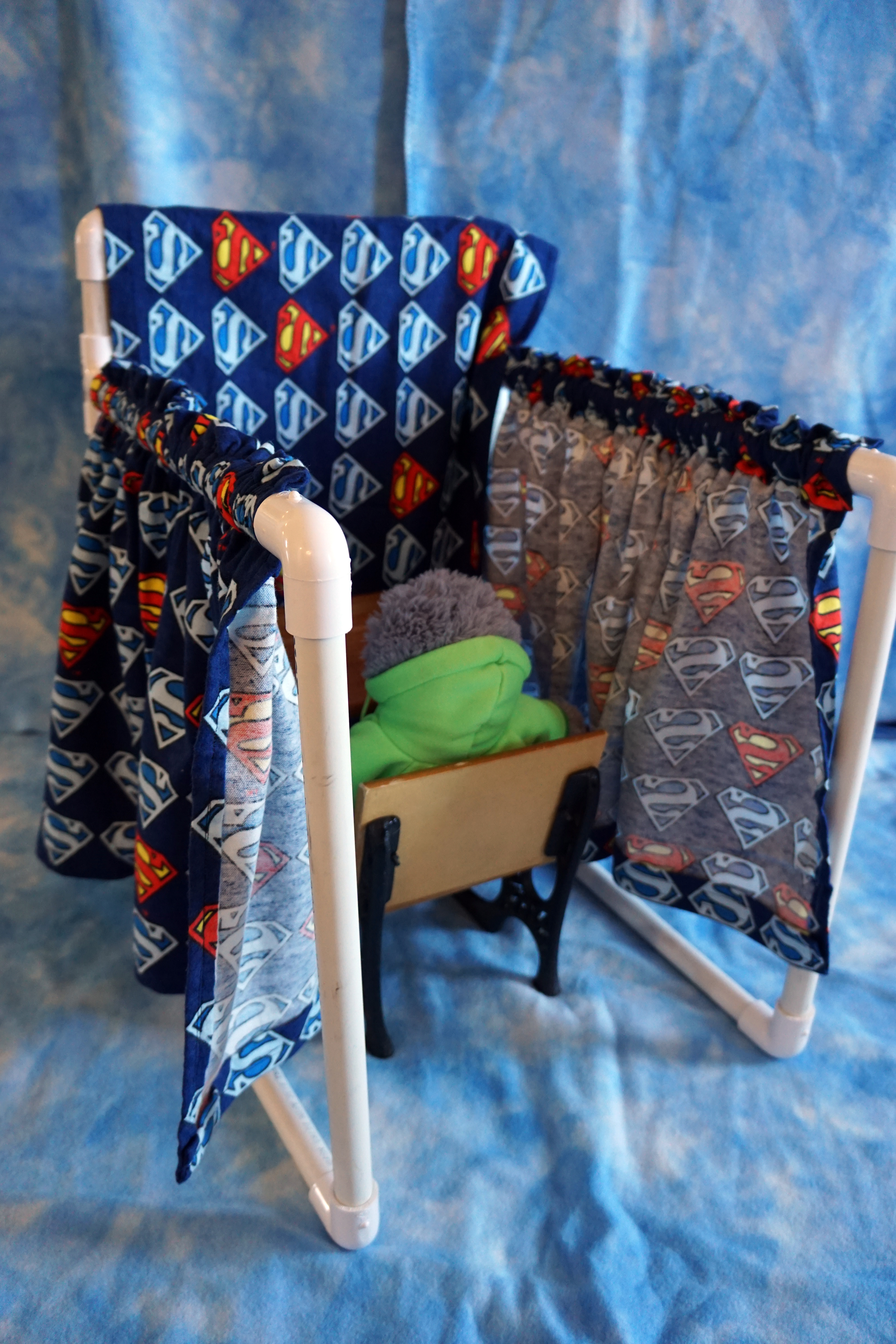
    Finished DIY quiet area with Superman-print fabric panels hung on PVC frame, with a small school desk inside and a sloth stuffed animal
    The finished quiet area

    Size Guide

    Adjust your pipe lengths to fit the furniture you’re working with:

    UseApprox. top rail sizeApprox. height
    School desk24″ × 20″36–40″
    Standard table36″ × 24″40–48″
    Bean bag nook30″ × 30″48–54″

    These are starting points — measure your actual furniture and add a few inches of clearance on each side. The angled legs will add width at the base, so account for that in your space planning.

    Tips to Make It Even Better

    • Choose soft fabric
    • Add soft lighting. A small battery-powered LED light inside makes it cozy without any wiring.
    • Include a small fan. White noise and airflow can help with sensory regulation.
    • Stock it with tools. Noise-canceling headphones, a fidget, or a calm-down kit tucked inside makes it a complete sensory toolkit.
    • Label it positively. Call it the “Focus Spot,” “Cozy Corner,” or whatever name the child comes up with — never a punishment space.

    Show Us Yours!

    If you build one of these, we’d love to see it. Share a photo in the comments or tag us — especially if the child picked a great fabric theme. These are always better when backed by a strong opinion about superheroes.
  • Sensory Considerations in the Classroom 8/25/26

    Sensory Considerations in the Classroom 8/25/26

    Sensory Considerations in the Classroom

    The beginning of a new school year brings excitement, new routines, and lots of activity. For some children, it can also bring a great deal of sensory input.

    Bright lights. Busy walls. Loud voices. Chairs scraping. Strong smells. Crowded transitions. New materials. New people.

    What feels like an ordinary classroom environment to one child may feel overwhelming to another.

    That is why sensory considerations are such an important part of creating an inclusive classroom.

    Sensory Needs Are Different for Every Child

    Children experience their surroundings in different ways. Some children may be especially sensitive to sounds, lights, textures, movement, or smells. Others may actively seek sensory input and seem to need frequent opportunities to move, touch, push, pull, or explore.

    And sensory needs are not limited to children with a diagnosis.

    A child who is tired, anxious, hungry, adjusting to school, or simply having a difficult day may also have a harder time managing the classroom’s sensory demands.

    Look at the Classroom Environment

    One of the most helpful things teachers can do is simply walk through the classroom and notice what children are experiencing.

    Consider:

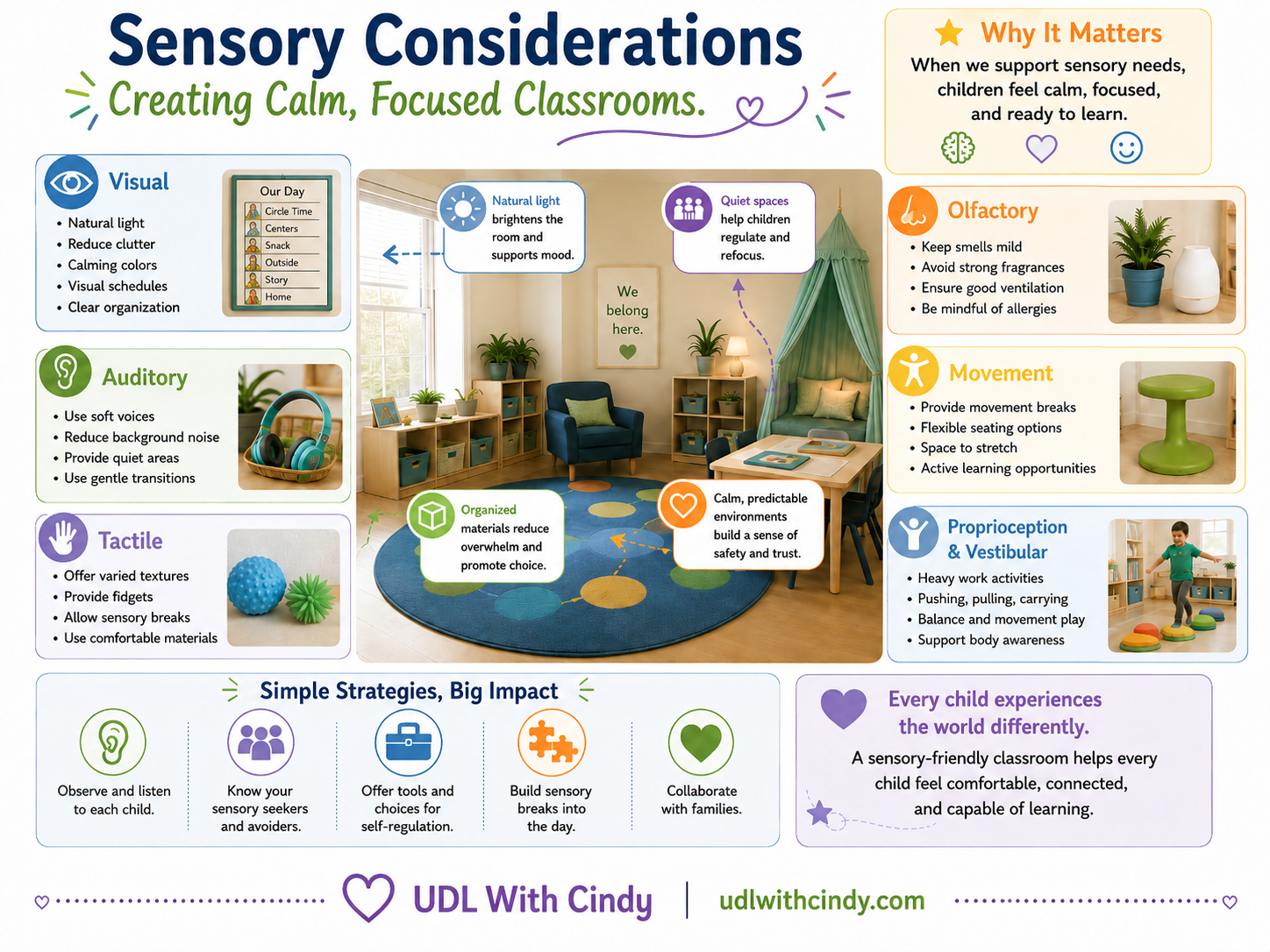
    • Visual: Is the room extremely busy or cluttered? Are schedules and materials easy to find?
    • Auditory: Is there constant background noise? Are there quieter areas children can use?
    • Tactile: Are children offered a variety of comfortable materials and textures?
    • Olfactory: Are strong fragrances, cleaning products, or other smells present?
    • Movement: Are children expected to sit for long periods, or are movement opportunities built into the day?
    • Proprioceptive and vestibular: Are there safe opportunities for pushing, pulling, carrying, balancing, stretching, and whole-body movement?

    The goal is not to create a perfectly quiet or completely stimulation-free classroom.

    Children need rich, interesting environments.

    The goal is to create an environment that gives children options and helps them regulate when the classroom becomes too much—or when they need more input.

    Simple Supports Can Have a Big Impact

    Sensory-friendly classroom supports do not have to be expensive or complicated.

    A few possibilities include:

    • creating a quiet or cozy space
    • using visual schedules and predictable routines
    • reducing unnecessary clutter
    • providing flexible seating choices
    • offering sensory or movement breaks
    • keeping noise-reducing headphones available
    • allowing children to stand or move while learning
    • providing fidgets or appropriate hands-on materials
    • using natural light when possible
    • giving children a way to communicate when they need help or a break

    Most importantly, observe the individual child.

    One child may calm by rocking, while another needs to move. One may enjoy music, while another covers their ears. One child may love messy sensory play, while another avoids it completely.

    There is no single sensory strategy that works for every learner.

    The UDL Connection

    Universal Design for Learning encourages us to plan for learner variability from the beginning rather than waiting until a child struggles.

    Sensory supports fit naturally into that mindset.

    When classrooms provide choices in seating, movement, communication, materials, and ways to participate, we are designing an environment that works for more children from the start.

    And many of these supports benefit everyone—not only children with identified sensory needs.

    A quieter corner can help a child who is overwhelmed.

    A visual schedule can help a child learning English.

    A movement break can help a child who has been sitting too long.

    A predictable routine can reassure a child who is nervous about coming to school.

    That is the beauty of inclusive design.

    Start Small

    You do not need to redesign your entire classroom.

    Choose one area to notice this week.

    Every child experiences the world differently. When we create classrooms that recognize those differences, we help more children feel comfortable, connected, and ready to learn.